

Lease Plans for Commercial Property
Commercial lease plans must capture yards, mezzanines, shared services and access. Here is how the demise is defined for offices, retail and industrial units.
Do commercial lease plans cost more than residential?
Usually, yes.. Commercial premises tend to be larger and more complex, often including yards, mezzanines, loading areas and shared services, so commercial lease plans are £299 + VAT for one property up to and including 1,000 sq ft, compared with £199 + VAT for residential. Additional area above 1,000 sq ft is charged at 10p per sq ft + VAT. Multiple commercial plans at one location are charged at £279 + VAT each.
Why commercial plans are more complex
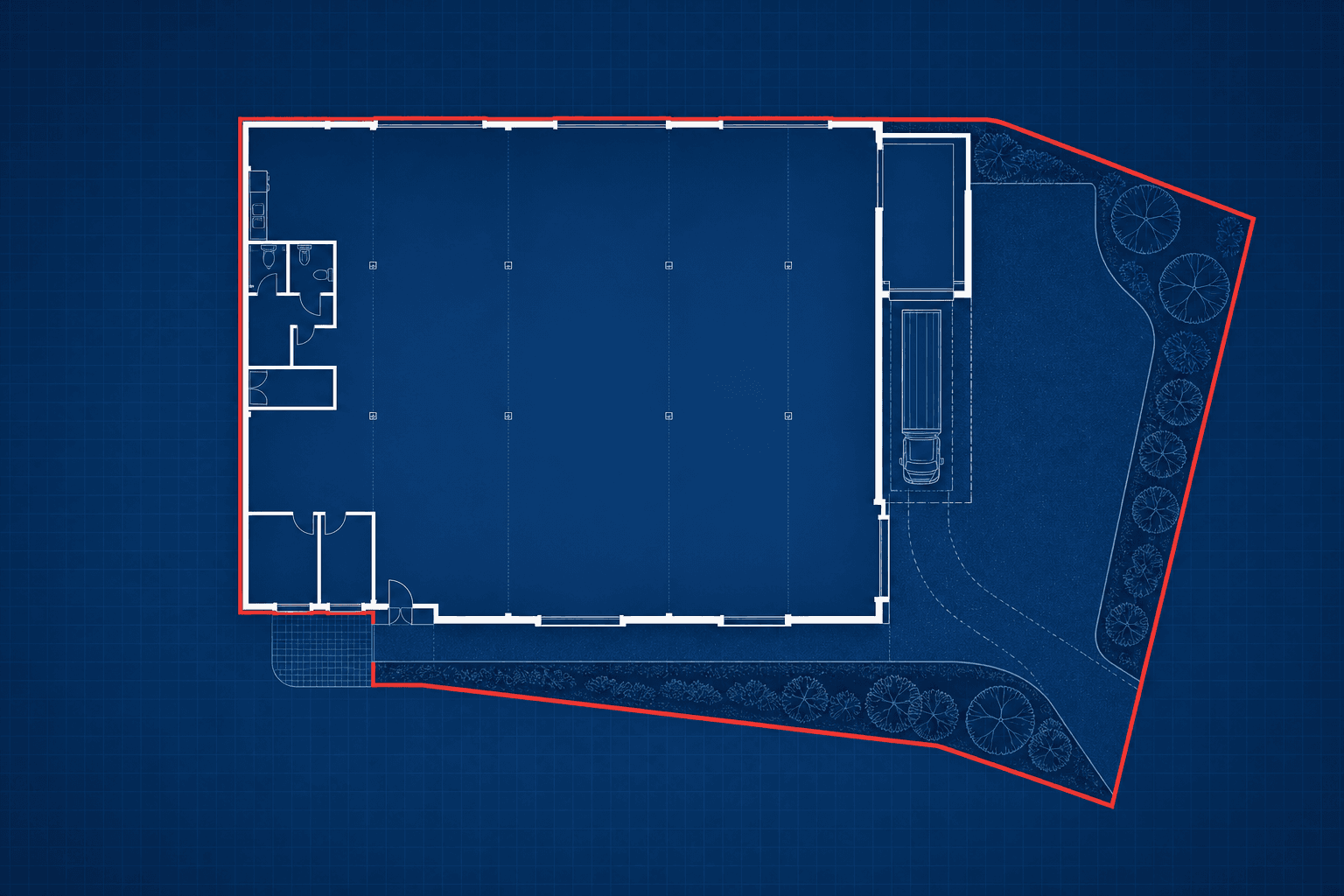
Commercial premises tend to be larger and more varied than residential flats. The demise can include mezzanine floors, yard areas, loading bays, plant rooms and dedicated parking, and the building is often multi-let with shared cores, service corridors and refuse areas. The plan must capture all of this accurately.
Offices and multi-let buildings
In multi-let office buildings, the plan must distinguish the exclusively demised floor area from common parts — shared lifts, stairwells, WCs and reception — and from any areas held in common. Clear separation prevents overlapping demises between tenants on different floors.
Retail, industrial and external areas
Retail units may include external seating or storage; industrial units frequently include yards, loading docks and mezzanine storage. These external and ancillary areas must be measured and shown, along with any rights over shared estate roads and service yards.
Portfolios and consistency
For landlords and managing agents with multiple units at one location, consistent drafting across the building is important so the plans read together without conflict. We offer reduced per-plan pricing for multiple commercial plans at one location and coordinate the survey programme to keep costs down.
Need a new title or transfer of part plan?
We prepare Ordnance Survey-aligned application plans for transfers of part, first registrations, plot sales and title splits across England and Wales. Send us the property details for a fixed-price quote.