

Lease Plans for Flats
Flats almost always need a lease plan because they form part of a larger building. Here is what the plan must show and how shared areas are handled.
Do I need a lease plan for Land Registry?
Yes.. Since October 2003, all leases granted for more than seven years — and existing leases with more than seven years left — must be registered with HM Land Registry, and the application must include a compliant lease plan. You also need one to extend a lease, vary a lease, or transfer part of a registered title. Without an accepted plan, the registration cannot proceed.
Why flats need a lease plan
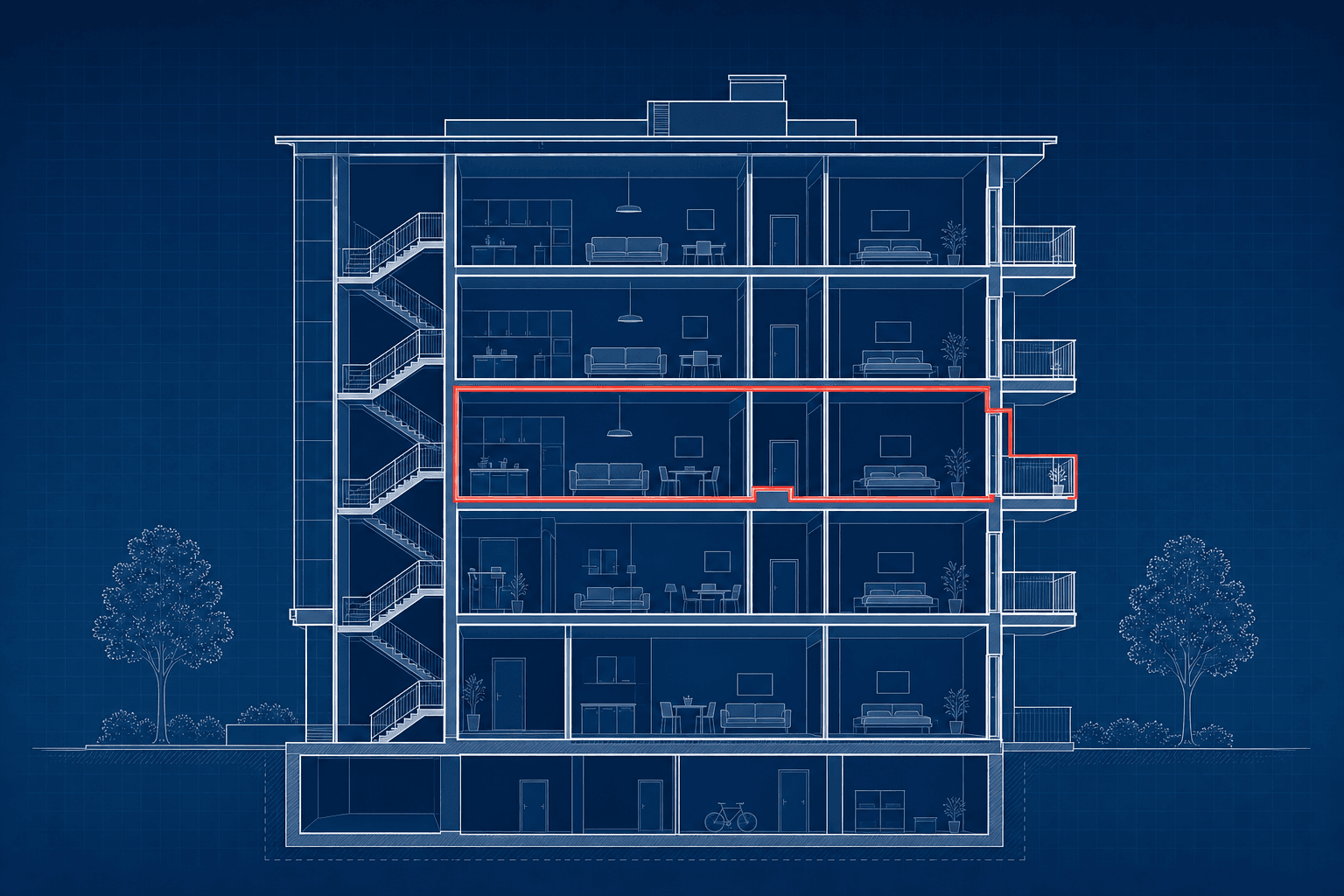
A flat is part of a larger building, so the lease must define exactly which area within that building is demised. This is impossible to do with words alone, which is why a scaled lease plan with the demise edged in red is required to register the lease, extend it, or transfer it.
Showing the demise and communal areas
The plan shows the flat’s internal layout to scale, edged in red, and distinguishes it from communal areas — entrance halls, staircases, lift lobbies, bin and bike stores — which are usually shown in green. Any storage cupboard, balcony, terrace or parking space included in the lease must be shown in its correct position.
Conversions vs purpose-built blocks
Period houses converted to flats often have irregular layouts, shared rear access and communal gardens that need careful measurement. Purpose-built blocks are more regular but introduce shared cores, concierge areas and roof terraces. Both require the demise to be clearly separated from the shared parts.
Floor levels and multi-storey flats
Maisonettes and split-level flats span more than one floor, so the plan must label each floor level and show the demise on each. Internal stairs within the demise should be shown. Clear floor labelling helps HM Land Registry and future owners read the plan correctly.
Need a lease plan?
We produce Land Registry compliant lease plans across England and Wales. Send us the property details for a fixed-price quote.